Location Tracking for Families: 10 Everyday Situations Where It Helps
Knowing where family members are can provide practical reassurance during everyday travel, school commutes, work trips, and unexpected situations. With a reliable family location tracker, parents and caregivers can use location sharing to stay connected without constantly calling or messaging for updates.
A live location tracker can show a family member’s current or recent location, depending on the device and tracking setup. This can be especially useful for children, teenagers, elderly family members, and anyone travelling alone.
But location tracking is most useful when it is used responsibly—with the knowledge and permission of the people being tracked. The goal should be safety, coordination, and peace of mind rather than unnecessary monitoring.
Here are 10 everyday situations where family location tracking can make a practical difference.
What Is Location Tracking for Families?
Family location tracking uses technologies such as GPS, cellular networks, Wi-Fi, and sometimes Bluetooth to determine or share a device’s approximate location.
A family member may use a smartphone, smartwatch, or dedicated GPS tracking device. Depending on the product, authorized family members can view the location through an app.
A family location tracker can be useful for:
- Checking whether a child has reached school
- Coordinating family members during travel
- Knowing when someone is approaching home
- Helping locate a family member during an emergency
- Supporting elderly relatives who may need additional assistance
- Creating location-based safety alerts
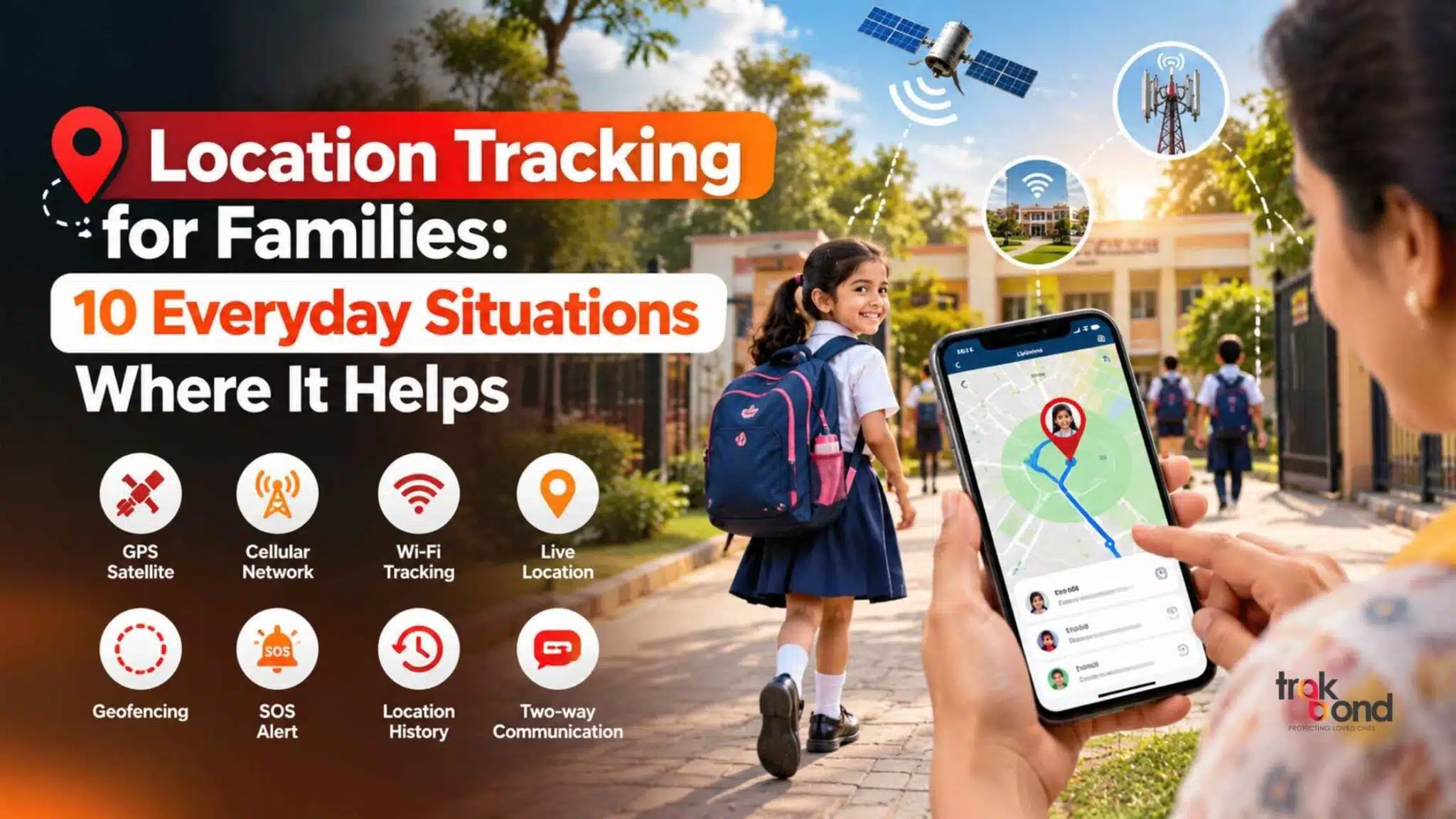
Modern tracking solutions can also offer features such as geofencing, location history, SOS alerts, and route information.
10 Everyday Situations Where a Family Location Tracker Helps
1. Children Travelling to and From School
One of the most common reasons parents use location tracking is to stay informed about a child’s school commute.
Children may travel by school bus, public transport, bicycle, or with a parent or caregiver. Instead of repeatedly calling to ask where they are, parents can use an approved tracking device to check their location.
For younger children, a dedicated GPS tracker or GPS-enabled wearable can provide an additional layer of reassurance.
Parents may also create important locations such as:
- Home
- School
- Daycare
- Tuition centre
- Sports academy
If the tracking solution supports geofencing, an alert can notify the parent when the child enters or leaves a predefined area.
This makes location track technology useful as a safety and coordination tool rather than simply a monitoring system.
2. When Teenagers Travel Independently
As children become teenagers, they often start travelling independently—to school, coaching classes, friends’ homes, shopping areas, or extracurricular activities.
Parents naturally want to give teenagers more independence while still having a basic way to check their safety.
A live location tracker can help bridge that gap.
Instead of asking for frequent calls or messages, teenagers can share their location with authorized family members. Parents can check the location when necessary and allow their children greater freedom.
The important point is consent and communication. Teenagers should understand what is being shared, who can see it, and why it is being used.
3. Family Road Trips and Holidays
Family vacations can involve unfamiliar roads, crowded tourist destinations, airports, railway stations, and large public areas.
Location sharing can make coordination easier when family members become separated.
For example, one person may be shopping while another is waiting near a restaurant. Rather than exchanging detailed directions, family members can use shared location information to find each other.
A family location tracker can also be useful when travelling with children who may wander away in crowded places.
For longer journeys, location information can provide an additional layer of reassurance when family members are travelling separately.
4. After-School Activities and Coaching Classes
Children today often have busy schedules involving tuition, coaching classes, music lessons, sports training, dance classes, and other activities.
Parents may not always be able to accompany them.
A location tracker can help parents confirm whether a child has reached a regular destination or started the journey home.
For example, if a child normally attends a sports academy from 5 PM to 6:30 PM, location information can help parents understand whether they are still at the activity centre or have begun travelling home.
This can reduce unnecessary phone calls while helping families coordinate busy schedules.
5. When an Elderly Family Member Goes Out Alone
Location tracking isn’t only for children.
Older adults may sometimes travel to medical appointments, markets, parks, religious places, or other familiar destinations without another family member.
For families, knowing that an elderly relative has reached their destination can provide reassurance.
A suitable tracking device can also be useful when the person carries a phone or wearable that supports location sharing.
Some solutions may provide additional safety features such as SOS alerts. If the person feels unsafe or needs assistance, an emergency alert can help notify selected contacts.
However, elderly family members should understand the purpose of tracking and agree to the arrangement.
6. During Emergency Situations
Unexpected situations can happen anywhere.
A family member may get lost, take the wrong route, experience a transportation problem, or find themselves in an unfamiliar area.
In these situations, location information can help family members understand where the person was recently located.
If the device supports live location and the person has connectivity, an authorized family member may be able to see their current position.
An SOS feature can provide another useful layer. Depending on the device or service, pressing an SOS button may send an alert to selected contacts.
Location tracking does not replace emergency services, but it can provide useful information when families need to respond quickly.
7. When a Child Is Travelling With a School or Activity Group
Children sometimes travel for school trips, competitions, camps, sports events, and educational activities.
Parents may not be travelling with them, which can naturally create concern.
A location-enabled device can help parents stay informed about a child’s journey, where supported by the school’s arrangements and applicable permissions.
For group trips, location information can be particularly useful when travelling through unfamiliar areas.
Parents should always follow the school’s policies and ensure that tracking is used with appropriate consent.
8. Coordinating Pickups and Drop-Offs
Family schedules don’t always match.
A parent may need to pick up a child from school while another family member is returning from work. Traffic and delays can make timing difficult.
Location sharing can make these everyday arrangements easier.
For example, a parent could check whether another authorized family member has already left work before starting the pickup journey.
Similarly, family members can coordinate meeting points without making multiple calls.
A live location tracker can therefore be useful not only for safety but also for everyday family logistics.
9. When Someone Is Travelling Alone
Solo travel can be exciting, but families may still want reassurance when a loved one is travelling alone.
This could include:
- A teenager travelling to another city
- A parent travelling for work
- An elderly relative visiting another location
- A family member taking a long-distance train
- Someone travelling late in the evening
Sharing location with a trusted family member can provide peace of mind.
A simple agreement can work well: the traveller shares their location during the journey and informs the family once they reach the destination.
This approach balances independence with reasonable safety precautions.
10. Finding a Family Member in a Crowded Place
Large malls, railway stations, airports, festivals, fairs, amusement parks, and tourist attractions can make it surprisingly difficult to find someone.
Instead of repeatedly asking, “Where are you?”, family members can use location sharing to coordinate.
Parents can also establish simple family rules for crowded environments—for example, choosing a meeting point and ensuring that children know whom to contact if they become separated.
Technology should support these safety habits, not replace them.
What Features Should You Look for in a Family Location Tracker?
If you are exploring a location-tracking solution for your family, don’t choose an app or device based only on whether it displays a map.
Consider the complete safety and privacy experience.
1. Live Location
A useful live location tracker should provide location information with reasonable accuracy and timely updates, subject to GPS, network, battery, and device conditions.
2. Geofencing
Geofencing allows families to define locations such as home, school, or tuition centre and receive alerts when a device enters or leaves the area.
3. SOS Alerts
An SOS feature can be valuable during unexpected situations, particularly for children and elderly family members.
4. Location History
Location history can help authorized users understand previous routes or confirm whether someone visited a particular location.
The amount and duration of stored information vary between services, so privacy policies should be checked carefully.
5. Reliable Connectivity
GPS alone does not guarantee that a location will appear in an app. Tracking devices may depend on cellular networks, Wi-Fi, GPS signals, or combinations of these technologies.
6. Privacy and Security
Privacy should be a major consideration.
Before choosing a family location tracker, check:
- Who can access the location?
- Is location data encrypted?
- Is data shared with third parties?
- How long is location information stored?
- Can family members control location sharing?
- What happens if the device is lost?
A trustworthy solution should make these policies understandable.
How Trakbond Can Support Family Location Tracking
Trakbond is designed around connected family safety, helping parents and families stay connected with location-based technology.
Depending on the Trakbond device and plan, families can use features such as GPS location tracking, live location information, geofencing, SOS alerts, location history, and calling capabilities.
Trakbond’s approach is particularly relevant for parents looking for a dedicated tracking solution rather than relying entirely on a child’s smartphone.
For younger children, a dedicated tracker can offer location-based safety without introducing the same distractions associated with a full-featured smartphone.
The goal is simple: help families stay connected while giving children and loved ones appropriate independence.
Location Tracking vs. Constant Monitoring
It is important to understand that location tracking should not become constant surveillance.
Healthy family tracking starts with clear communication.
Parents can explain:
- Why location sharing is being used
- Who can access the location
- When tracking is necessary
- What information is stored
- When location sharing can be turned off
For children and teenagers, this conversation can also become an opportunity to teach digital safety and responsible technology use.
The best family tracking setup is one that increases safety without unnecessarily reducing trust.
Is a Family Location Tracker Worth Using?
For many families, location tracking can be a practical safety tool.
It can help parents coordinate school pickups, check a child’s journey, stay connected during holidays, support elderly relatives, and respond more effectively to unexpected situations.
However, the value depends on choosing the right technology and using it responsibly.
A reliable live location tracker should combine useful location information with privacy, security, connectivity, and easy-to-use safety features.
Frequently Asked Questions
What is a family location tracker?
A family location tracker is an app, wearable, smartphone feature, or dedicated GPS device that allows authorized family members to share and view location information.
How does a live location tracker work?
A live location tracker generally uses GPS along with cellular networks, Wi-Fi, or other positioning technologies to determine a device’s location and transmit that information to an authorized app or platform.
Is location tracking useful for children?
Yes. Location tracking can help parents coordinate school commutes, extracurricular activities, travel, and emergencies. It should always be used appropriately and with age-appropriate communication and consent.
Can location tracking work without GPS?
Some tracking systems can use cellular networks, Wi-Fi, or other positioning methods when GPS signals are unavailable or weak. Accuracy depends on the device, network, environment, and technology being used.
What is the difference between a family location tracker and a normal location-sharing app?
A family location tracker may be designed specifically around family safety and can include features such as geofencing, SOS alerts, location history, dedicated GPS hardware, and other safety functions. A standard location-sharing app may focus primarily on sharing a smartphone’s location
Is location tracking safe for privacy?
It can be, provided that location information is shared with trusted people and the service follows strong security and privacy practices. Families should review data collection, storage, access, and sharing policies before choosing a tracking solution.
Final Thoughts
Location tracking has become more than simply finding a device on a map. Used responsibly, it can help families manage everyday journeys, coordinate busy schedules, support children and elderly relatives, and respond to unexpected situations.
From school commutes and coaching classes to family holidays and emergency situations, there are many practical reasons to use a family location tracker.
The key is to combine technology with trust. Choose a solution with useful safety features, reliable connectivity, strong privacy controls, and an interface that the whole family can understand.
For families exploring dedicated tracking technology, solutions such as Trakbond can provide a practical way to stay connected through location-based safety features—helping loved ones enjoy greater independence while giving families additional peace of mind.